DockMaster Reviews and Capabilities
A practical look at how DockMaster supports marine operations and daily workflows.
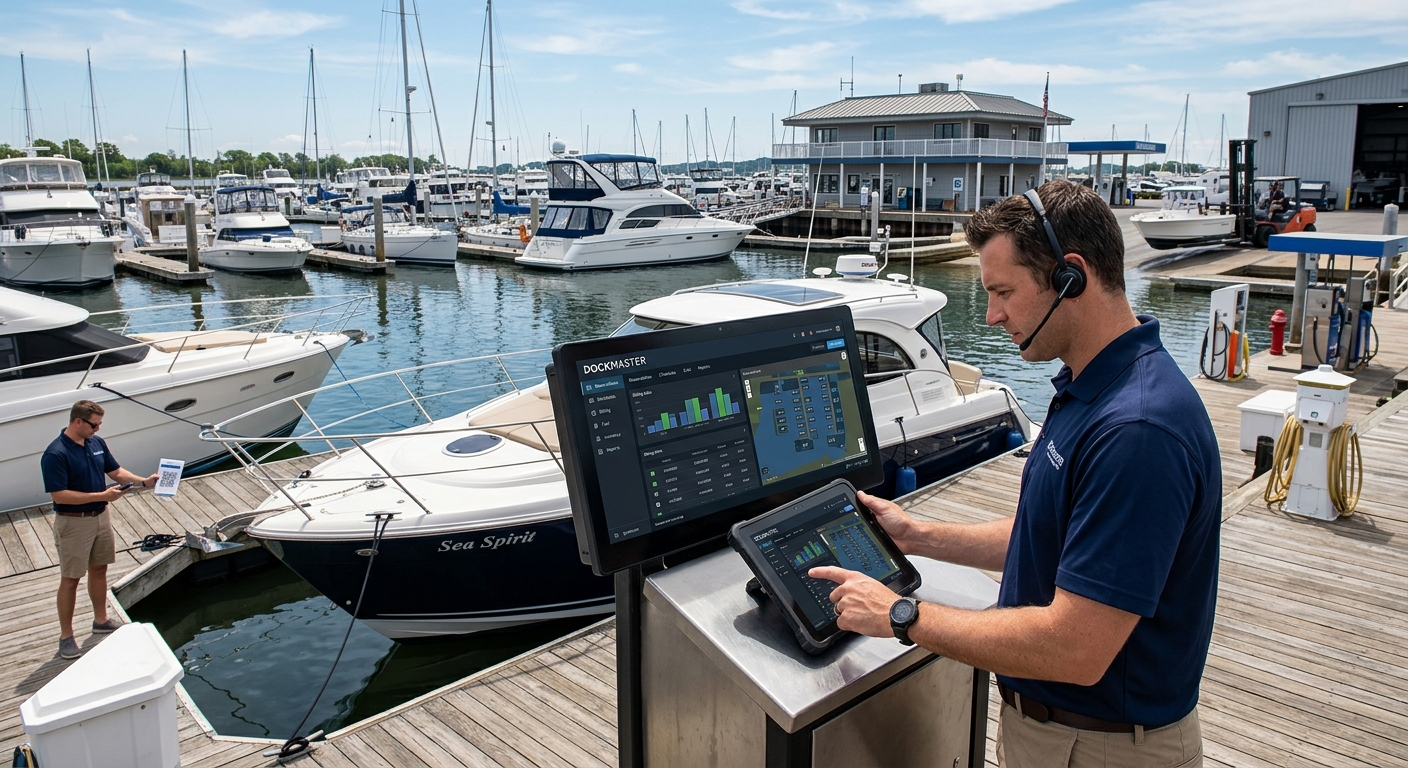
DockMaster is built for marine businesses that need more than a basic scheduling tool. It brings together operational work, customer records, billing tasks, service coordination, and storage management in one environment. For marinas, boatyards, and boat dealerships, that combination can reduce the friction that comes from switching between spreadsheets, email threads, and disconnected systems.
What makes DockMaster interesting is not just that it covers many administrative jobs, but that it tries to reflect the real flow of marine operations. A vessel may need a haul-out, a work order, parts tracking, slip assignment, storage billing, or a follow-up service ticket. When those steps live in separate tools, information gets lost. A system like DockMaster aims to keep the process visible from beginning to end.
This article looks at the platform from a practical perspective: what it appears designed to handle, where it fits best, and what kinds of organizations may get the most value from it. The goal is to help decision-makers understand the software in plain language rather than through marketing language.
Why marine operators look for specialized software
General business software can handle invoices or calendars, but marine operations tend to have unique requirements. A marina may need to track slips, rack storage, seasonal occupancy, fuel activity, launches, and service jobs all at once. A dealership may need more sales-focused tools, while a boatyard may need stronger work order visibility and labor tracking.
Specialized software is useful because it maps to those workflows more directly. Instead of forcing staff to build awkward workarounds, the system can support day-to-day actions in a way that matches the business. That often improves speed, reduces duplicate entry, and makes reporting more reliable.
- Teams can connect customer information with service and billing records.
- Managers can monitor occupancy and storage usage in real time.
- Service departments can track job progress and materials more consistently.
- Front office staff can respond faster because information is centralized.
For operations that involve seasonal demand, changing storage needs, and a mix of sales and service, this kind of alignment can be especially valuable.
Core functions that matter in daily operations
DockMaster is often described as a broad management system, and that description fits its role. Rather than focusing on just one department, it supports several interconnected functions. That matters because marine businesses rarely operate in silos. The same customer may rent storage, request repairs, and receive billing statements from different parts of the organization.
One of the platform’s central strengths appears to be its ability to manage work orders. In a marine setting, a work order is not merely a task list. It can involve service notes, labor assignment, parts usage, timestamps, and customer communication. When those details are organized together, managers can better understand what is happening on the dock or in the yard.
Another key area is billing. Marinas and boatyards often bill for storage, labor, launches, slips, fuel, and other services. DockMaster is intended to support these billing flows from the same environment that manages operations. That reduces the chance of billing gaps or mismatched records.
| Operational Area | Why it matters | Typical benefit |
|---|---|---|
| Work orders | Tracks repair and service activity | More visibility into job status |
| Storage and occupancy | Manages space usage and placement | Better utilization of marina assets |
| Billing | Handles recurring and service-related charges | Cleaner invoicing and fewer manual steps |
| Reservations | Organizes customer bookings and scheduling | Improved coordination during busy seasons |
| Customer records | Links clients with jobs and payments | Faster service and easier follow-up |
Where the software can be especially useful
Not every marine business needs the same level of system depth. DockMaster is most appealing to organizations that deal with several moving parts at once. That includes marinas that manage slips and storage, boatyards that handle repair work, and dealerships that want stronger operational control alongside sales activity.
Businesses with multiple locations may also see value in a system that helps keep records aligned across sites. When staff members at different branches need to see the same customer or vessel details, a shared platform can reduce confusion and improve consistency.
It may also be a strong fit for organizations that have outgrown lighter tools. A team may begin with manual billing and basic scheduling, then later find that rising volume creates more administrative work than people can comfortably manage. At that point, software with a broader feature set becomes less of a luxury and more of a necessity.
- Marinas: useful for slips, launches, storage, and customer billing.
- Boatyards: helpful for work orders, labor, and service tracking.
- Boat dealerships: valuable when sales and post-sale service need to be connected.
Integration and workflow continuity
In modern operations, software rarely works well if it stands alone. Marine businesses often rely on other tools for communication, fuel handling, payment processing, or digital scheduling. A major consideration for any management platform is how well it plays with the rest of the business ecosystem.
DockMaster is associated with integration support that can connect marine operations to other applications. That matters because staff members should not have to retype the same details into multiple systems. When systems share data more effectively, the business can spend less time on administration and more time on customer service and actual field work.
Workflow continuity is equally important. A reservation should be able to lead naturally into storage or launch preparation. A service issue should become a work order. A completed job should translate into a bill without major delays. In a well-organized system, each step feeds the next.
That continuity also supports management oversight. If a manager wants to understand which jobs are still open, which slips are occupied, or which customers have unpaid balances, a connected system can make those answers easier to retrieve.
Potential advantages for busy teams
One reason organizations consider systems like DockMaster is the promise of operational clarity. When a business handles many vessels, many customers, and many forms of revenue, the old methods of tracking information can become fragile. A centralized platform can help staff keep a tighter handle on the day’s work.
Below are some of the most practical advantages a marine business may expect from a system in this category:
- Centralized information: customer, vessel, service, and billing data can live in one place.
- Better task coordination: teams can see what needs to happen next and who is responsible.
- Improved accountability: job history and timestamps help explain what occurred and when.
- More consistent billing: linked records reduce the risk of missed charges.
- Scalability: a larger business can standardize processes across more than one site.
In practice, these benefits are less about flashy features and more about reducing friction. Staff members save time when they do not need to reconcile multiple sources of truth. Managers gain confidence when reporting reflects current activity. Customers benefit when service and billing feel organized.
Things buyers should evaluate before choosing it
Even if DockMaster is a strong operational fit, any software purchase should be evaluated carefully. Businesses should look beyond the feature list and think about implementation, training, and everyday usability. A broad system can be powerful, but it also needs to be adopted successfully by the staff who will use it most often.
One issue to consider is complexity. The more functions a platform offers, the more important setup and onboarding become. Teams should ask whether the software can be configured to match their processes without creating unnecessary complications. They should also consider how much time employees will need to learn the interface and whether support resources are available during rollout.
Another factor is fit with current processes. A marina that uses simple procedures may not need every advanced feature right away. In that case, it helps to identify the must-have items first: reservations, storage billing, work orders, reporting, or sales support. That keeps the evaluation grounded in business needs rather than abstract feature comparisons.
| Evaluation Question | Why it matters |
|---|---|
| Does the system match your core workflows? | Fit determines whether the software saves time or adds extra steps. |
| How much training will staff need? | Adoption depends on how quickly employees can use it confidently. |
| Can it support growth or multiple locations? | Scalability matters if the business is expanding. |
| How will data be migrated? | Switching systems can be difficult without a clear migration plan. |
| What integrations are required? | Compatibility with existing tools affects long-term value. |
How DockMaster compares conceptually with lighter tools
Some businesses begin with basic scheduling software, spreadsheets, or accounting tools and later discover they need something more integrated. DockMaster represents a different approach: a platform built to support a broader marine operation instead of just a single task.
That difference can be useful when a company wants one system to manage many moving pieces. However, broader platforms are not automatically better for every organization. Smaller operations with limited staff may prefer a simpler product if their needs are narrow and stable. In contrast, businesses with more complex service and billing requirements may appreciate the depth of an all-in-one environment.
In other words, the right choice depends less on the brand name and more on the business model. The stronger the overlap between the software’s structure and the organization’s daily work, the more likely the platform is to deliver value.
Final perspective
DockMaster stands out as a marine-focused management system designed to help businesses coordinate operations, service, storage, reservations, and billing. Its value lies in bringing important workflows into a single framework so teams can act with better visibility and fewer manual handoffs.
For marinas, boatyards, and dealerships that need more structure than a generic tool can offer, the platform may be worth serious consideration. The strongest case for it is when a business wants to unify operational records and reduce administrative overhead across multiple departments or locations.
Still, the best software choice depends on the realities of the business. Companies should assess their workflow complexity, training capacity, integration requirements, and growth plans before moving forward. When those factors line up, a system like DockMaster can become more than software; it can become the backbone of how the operation runs.
Frequently asked questions
What is DockMaster used for?
DockMaster is used by marine businesses to manage tasks such as reservations, work orders, billing, storage, customer records, and operational tracking.
Who is DockMaster best suited for?
It is generally best suited for marinas, boatyards, and boat dealerships that need a more comprehensive system than basic scheduling or accounting tools.
Does DockMaster only handle billing?
No. Billing is only one part of the platform. It is intended to support a wider range of operations, including service coordination and storage management.
Why would a marine business choose a specialized system?
Specialized systems are built around the specific workflows of marine businesses, which can make daily operations more efficient and easier to manage.
What should a buyer ask before adopting it?
Buyers should ask whether the software fits current workflows, how much training it requires, what integrations are needed, and how easily it can scale with the business.
References
- DockMaster Documentation — DockMaster. 2026-05-21. https://portal.dockmaster.com
- Year In Review: DockMaster Introduces New Features And Improvements — DockMaster. 2026-05-21. https://www.dockmaster.com/blog/dockmasters-latest-version-includes-several-new-features-and-improvements
- DockMaster Software Reviews, Demo & Pricing – 2026 — Software Advice. 2026-05-21. https://www.softwareadvice.com/marine/dockmaster-profile/
- DockMaster Software Pricing, Alternatives & More 2026 — Capterra. 2026-05-21. https://www.capterra.com/p/92549/DockMaster/
- DockMaster 2026 Pricing, Features, Reviews & Alternatives — GetApp. 2026-05-21. https://www.getapp.com/industries-software/a/dockmaster/
Similar Articles




Read full bio of medha deb