
Docsmore Review: A Practical Guide
A clear look at how Docsmore streamlines document workflows and day-to-day business tasks.

Choosing document software is often less about flashy features and more about whether a tool removes friction from everyday work. Teams want a system that helps them build forms, gather information, route documents, and complete transactions without forcing users through a complicated setup. Docsmore is positioned around that kind of efficiency. Instead of functioning like a broad, all-purpose platform, it focuses on making business documents easier to create, share, and manage in a way that feels approachable for staff and clients alike.
This guide takes an original look at the kinds of problems Docsmore is designed to solve. It discusses the platform’s core strengths, where it may fit best, and what buyers should consider before adopting it. The goal is to provide a practical, plain-language overview for organizations evaluating document management software.
What Docsmore is meant to do
At its core, Docsmore is built to help teams work with documents more efficiently. That can include creating interactive forms, capturing information digitally, reducing manual back-and-forth, and supporting a more organized document process from start to finish. For businesses that handle repeatable paperwork, proposals, intake forms, approvals, or client-facing records, the appeal is simple: less time spent on administrative cleanup and more time spent on actual work.
One reason products like this matter is that document handling is still a major operational burden in many offices. PDF attachments, printed signatures, email chains, and copy-paste workflows are all easy to start but hard to scale. A platform that centralizes these steps can improve consistency and reduce errors.
Where the platform seems strongest
Based on the product’s positioning and user feedback themes, Docsmore appears to be strongest in environments that value speed, clarity, and low-friction adoption. It is especially appealing when users need to produce documents that are interactive rather than static. That means fields can be filled in digitally, actions can be tracked more easily, and the end result is easier to manage than a pile of emailed attachments.
Another advantage is accessibility. Tools that work in the browser and avoid heavy setup are often easier to roll out across small and mid-sized organizations. If a platform does not require plugins or complex installs, that can lower support demands and make it simpler for external users to complete documents without technical help.
Common capabilities buyers usually look for
When evaluating a document management tool, most buyers want a balanced set of features rather than a single standout function. Docsmore’s value is best understood in terms of workflow support. The following capability areas are likely to matter most to prospective users:
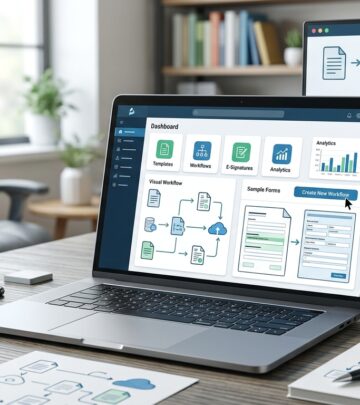
- Interactive document creation that allows users to complete forms digitally
- Trackable workflows so teams can monitor progress and status
- Web-friendly access that reduces technical barriers for signers or recipients
- Easy document editing and updating for routine business changes
- Support for administrative tasks like splitting or organizing files
- Transaction-related features for teams that need to collect payments alongside paperwork
These functions are not unusual on their own, but the quality of implementation matters. A tool becomes valuable when it keeps the document process simple enough that people actually use it consistently.
Why workflow simplicity matters
Document software can fail if it is too powerful for its own good. Teams may buy a robust platform and then use only a small fraction of it because the interface is too dense or the rollout requires too much training. Simpler systems can outperform larger suites when the real business need is straightforward.
Docsmore’s appeal is tied to reducing steps. If a document can be prepared, shared, completed, and tracked within one streamlined workflow, the organization gains time savings that are easy to feel day to day. Employees spend less time chasing files, and customers or clients encounter fewer obstacles when they need to respond.
Best-fit use cases for teams
Docsmore is most likely to appeal to teams with repetitive document workflows and moderate customization needs. For example, it may work well for businesses that handle client forms, intake packets, agreements, approvals, and routine administrative records.
It may also be useful for organizations that want a lighter-weight alternative to enterprise document systems. Smaller teams often need functionality that is dependable and clear rather than complex and highly specialized. In these settings, a focused platform can be easier to deploy and maintain.
| Use case | Why it may fit |
|---|---|
| Client intake | Interactive forms help standardize information collection. |
| Approvals | Trackable steps make it easier to monitor status. |
| Routine agreements | Web-based completion reduces delays and confusion. |
| Operational paperwork | Editable templates can reduce repetitive manual work. |
What users tend to value most
In software reviews, the most appreciated qualities are often practical rather than technical. For Docsmore, users are likely drawn to convenience, time savings, and document clarity. If a tool makes paperwork easier to understand and faster to finish, that benefit quickly becomes visible across departments.
Support quality can also play a major role in perception. When a product is used for business-critical documents, users want confidence that help is available if questions arise. Training materials, responsive assistance, and straightforward documentation can strongly shape the overall experience.
- Lower friction for everyday document tasks
- Less dependence on print-and-scan workflows
- Faster turnaround for forms and approvals
- More predictable document handling across teams
Potential drawbacks to consider
No document platform is right for every organization. A focused solution can be a strength, but it can also mean fewer advanced controls than larger enterprise suites. Buyers with complex governance requirements, highly specialized compliance workflows, or deep integration needs should examine the product carefully before committing.
Another consideration is scale. A tool that works well for a small or midsized team may not be the ideal choice for a much larger organization with multiple departments, strict permissions models, or layered approval chains. The better the match between product design and actual workflow, the better the long-term result.
It is also worth checking whether the platform supports the exact document types and business processes your team uses. A strong general-purpose workflow tool still needs to align with the details of your operations.
How to evaluate a document platform like this
When comparing Docsmore with alternatives, buyers should focus on the workflow itself rather than only the feature checklist. The best platform is the one that fits how people actually work. Before making a decision, consider the following questions:
- Can users complete documents without special technical steps?
- Does the system support the type of forms and records your team handles most?
- Is it easy to track document status from creation to completion?
- How much training will internal users and external recipients need?
- Does the platform reduce manual follow-up, or simply move the problem elsewhere?
These questions help separate a promising product from one that genuinely improves work. In many cases, the most useful system is the one that removes the most common annoyances from everyday operations.
A balanced take on the user experience
From a buyer’s perspective, a good experience usually depends on three things: setup, daily use, and support. If a document platform is intuitive enough to launch without heavy configuration, useful enough to support real workflows, and backed by helpful assistance when needed, it earns trust quickly.
Docsmore’s positioning suggests that it aims to offer that kind of practical balance. It does not need to be the most expansive product in the market to be valuable. For many organizations, the right tool is the one that gets people to completion faster with fewer manual steps.
FAQs
Is Docsmore mainly for small businesses?
It appears to be especially attractive to small and mid-sized teams that want straightforward document handling without a heavy implementation burden. However, the fit depends more on workflow complexity than company size alone.
Does Docsmore seem focused on interactive documents?
Yes. Its positioning suggests a strong emphasis on document interactivity, ease of use, and making forms easier to complete online.
What kinds of organizations might benefit most?
Businesses that manage recurring paperwork, approvals, and client-facing forms are likely to see the most value. The platform seems especially relevant where speed and clarity are more important than deep customization.
What should buyers test during evaluation?
They should test how easily documents can be created, shared, completed, and tracked. It is also smart to verify how well the platform handles the real documents and workflows used in day-to-day operations.
Final thoughts
Docsmore appears to be a practical document management option for teams that want to simplify paperwork without introducing unnecessary complexity. Its likely strengths are centered on usability, workflow clarity, and reducing the manual burden of handling forms and documents. For organizations that value speed, accessibility, and operational simplicity, that can be a compelling combination.
As with any software purchase, the best decision comes from matching the tool to the real business process. If your team needs a browser-friendly way to manage interactive documents and keep work moving, Docsmore may be worth a closer look.
References
- Health Insurance Portability and Accountability Act (HIPAA) — U.S. Department of Health & Human Services. 2024-01-01. https://www.hhs.gov/hipaa/index.html
- National Institute of Standards and Technology Privacy Framework — NIST. 2024-04-24. https://www.nist.gov/privacy-framework
- Electronic Signatures in Global and National Commerce Act (E-SIGN) — Congress.gov / U.S. Government Publishing Office. 2000-06-30. https://www.govinfo.gov/content/pkg/PLAW-106publ229/pdf/PLAW-106publ229.pdf
- Electronic Records; Electronic Signatures in Global and National Commerce — Federal Trade Commission. 2024-01-01. https://www.ftc.gov/business-guidance/resources/electronic-signatures-global-national-commerce-act
Similar Articles






Read full bio of Sneha Tete